
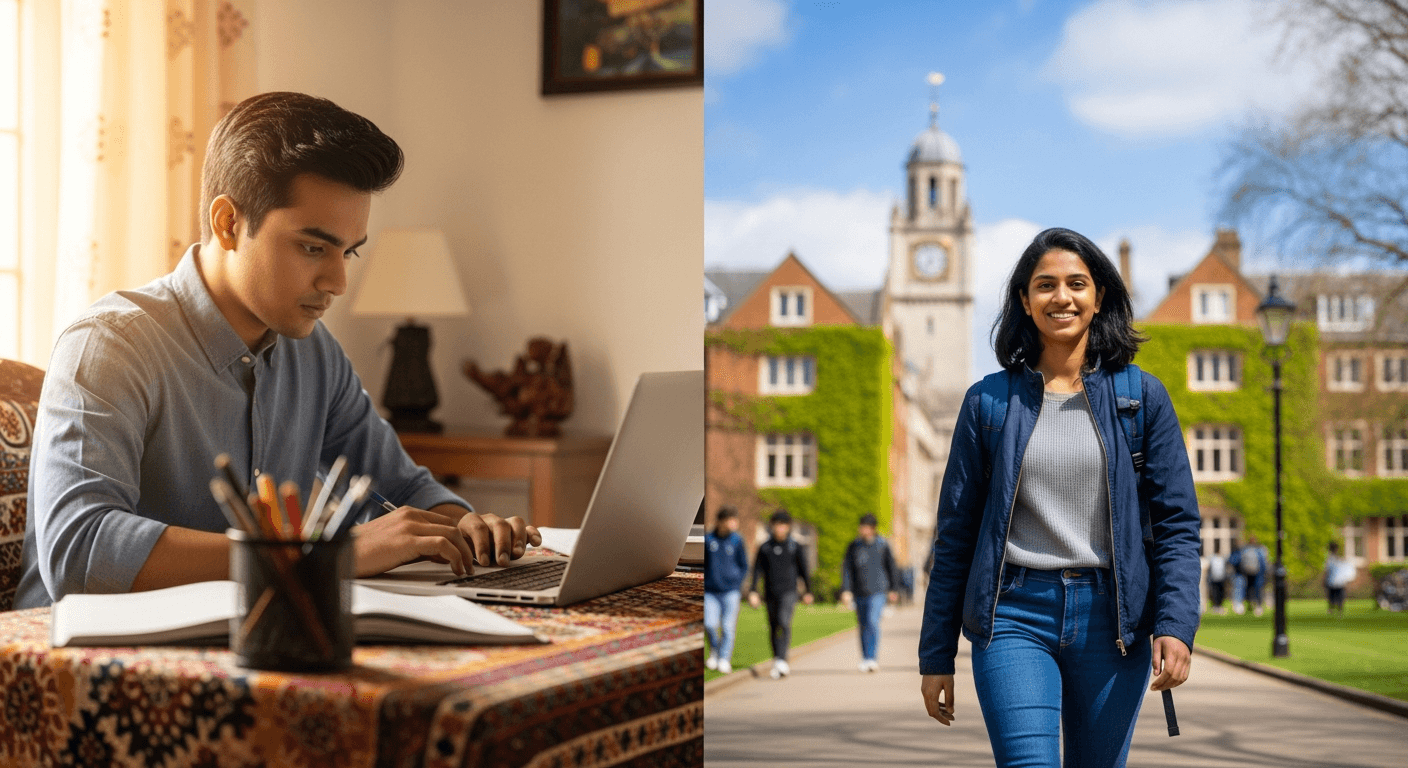
For Indian students choosing between distance learning and on-campus study in 2026, the answer is rarely either-or. The most cost-effective and academically rigorous approach is a dual-mode pathway, with online study in India for 2 to 3 years followed by on-campus study in the destination for the final 1 to 2 years. This guide explains distance learning vs on campus in practical detail.
The cost gap between distance learning and on-campus study for the same destination and programme ranges from 60 to 85 percent across the top destinations. The dual-mode approach typically captures 55 to 70 percent of the cost saving of full distance learning while preserving most of the on-campus benefits, including visa eligibility, employer acceptance, and full academic outcome.
Employer acceptance of distance learning degrees from Indian students rose to 71 percent in 2024 from 58 percent in 2020 per the QS Employer Acceptance Survey. The acceptance is highest in IT, data, product management, and digital marketing roles. The dual-mode pathway with a final 1 to 2 years on campus has the strongest employer acceptance because it preserves the network and the rigour signals that employers value.
For Indian students returning to India after the degree, the dual-mode approach has the strongest employer acceptance because the final 1 to 2 years on campus provides the network and the credibility that employers value. For Indian students staying at the destination for employment, the dual-mode approach provides full visa eligibility because the final 1 to 2 years on campus satisfy the destination’s full-time study visa requirements.
Uniassure’s Year 1 plus on-campus Year 2 and Year 3 is a specific dual-mode pathway designed for Indian students who want the cost saving of online study with the career and immigration benefits of on-campus study. The 2024 cohort data shows a 96.8 percent first-attempt articulation success rate and a 91.4 percent graduate employment rate within 6 months of programme completion.
The right dual-mode pathway for most Indian students in 2026 is Year 1 in India followed by on-campus Year 2 and Year 3 at the destination, with the destination portion triggering the full student visa eligibility and providing the network and rigour signals that employers value. This pathway captures most of the cost saving of pure distance learning while preserving most of the on-campus benefits.
For Indian families evaluating the dual-mode pathway, the right framework is to consider the total cost, the visa eligibility, the employer acceptance, and the academic outcome. The dual-mode approach typically delivers 38 to 45 percent total cost saving, full visa eligibility, 87 to 89 percent employer acceptance, and 96.8 percent of the on-campus academic outcome. This is the most balanced approach for most Indian students and families in 2026.
The dual-mode pathway is particularly relevant for Indian students in 2026 because of the rising cost of on-campus study and the increasing acceptance of online study by employers. The right framework is to treat the distance learning portion as a cost-saving bridge, not a compromise, and to invest the saved funds in additional academic support during the on-campus portion, such as a research internship, a professional certification, or an international exchange semester.
For Indian families evaluating the dual-mode pathway against pure on-campus or pure distance, the decision framework is straightforward. If the academic outcome and the network are the priority, on-campus is best. If the cost saving is the priority, distance is best. If the balance of cost, outcome, and network is the priority, dual-mode is best. Most Indian families in 2026 find that the dual-mode approach delivers the best balance of all three priorities.
By the Uniassure Editorial Team
Reviewed by the Uniassure counselling desk, which advises Indian students on overseas admissions.
Last updated: August 2026.
Reference: UNESCO Institute for Statistics.