Industry InsightsMay 29, 2026

Cost of Studying Abroad in 2026: A Country-by-Country Breakdown for Indian Families

7 min read
Cost of Studying Abroad in 2026: A Country-by-Country Breakdown for Indian Families

AI Summary

  • ✓ A three-year UK degree costs INR 45-60 lakh all-inclusive; Australia runs similar at INR 45-60 lakh, with living costs jumping 30% in five years.
  • ✓ The USA ranges from INR 60-1.2 crore depending on institution — private universities cost significantly more than public institutions.
  • ✓ Germany remains the most affordable option at INR 10-30 lakh total due to zero tuition fees at public universities.
  • ✓ Year 1 in India pathways reduce total degree cost by up to INR 20 lakh through lower tuition and living expenses during the first year.
  • ✓ Scholars must budget for annual tuition increases of 5-8%, health insurance, visa renewal fees, and return travel when calculating total education costs.

Studying abroad has never been cheap. But in 2026, the cost math has become genuinely alarming for middle-class families across India, Nigeria, and Southeast Asia. A single year at a UK university now runs between INR 15-20 lakh when you factor in tuition, rent, insurance, and the hidden cost of settling into a new country at 18. Multiply that by three or four years, and the total bill for a UK undergraduate degree lands between INR 45-60 lakh.

Australia tracks similar. The United States often runs higher, especially at private institutions. Even “affordable” destinations like Canada have seen tuition for international students climb 8-12% year-over-year since 2023.

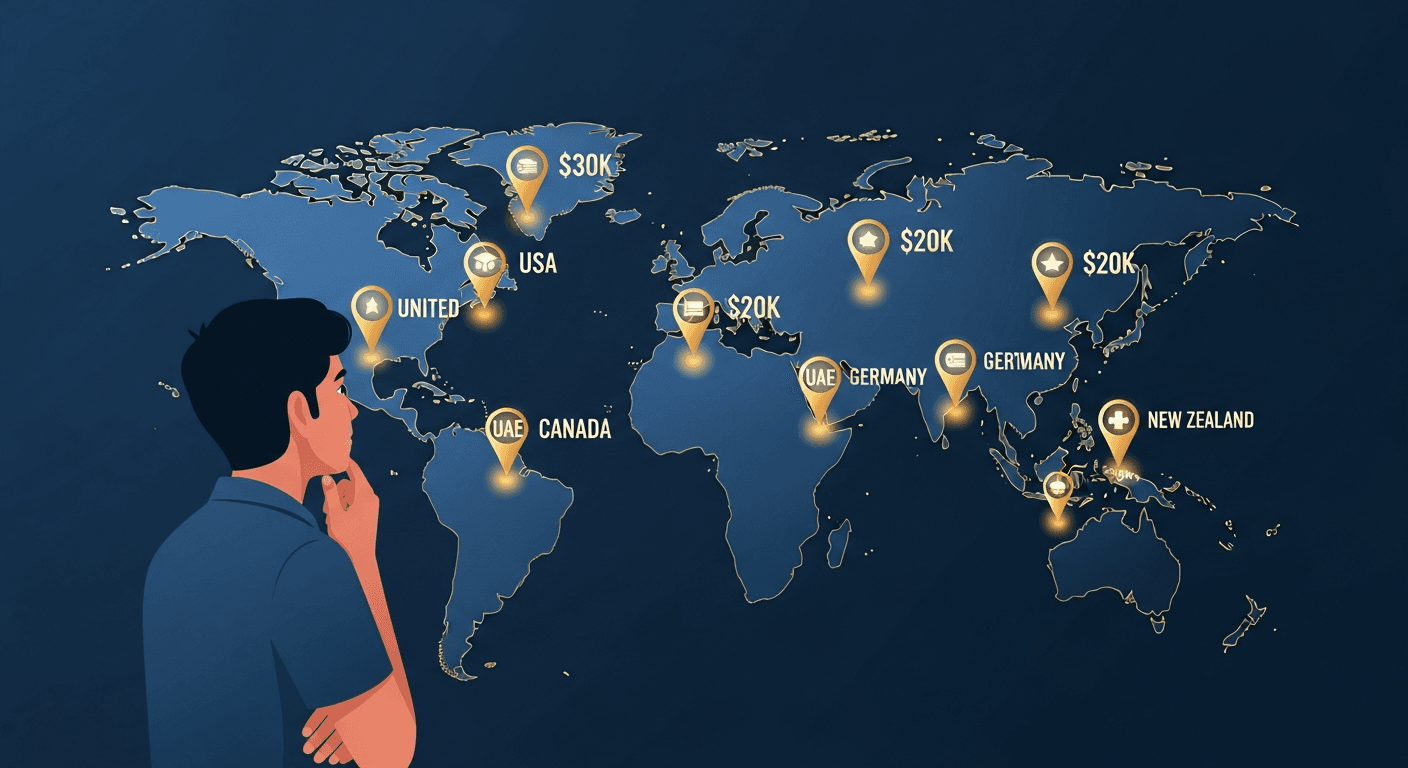
But here is what most families miss: the cost of studying abroad is not a single number. It is a sequence of decisions, and the first decision you make has an outsized impact on everything that follows. This guide breaks down the real numbers for 2026, compares costs across seven destinations, and shows how a Year 1 in India pathway model can cut your total spend by up to 40% without compromising on the degree you bring home.

The True Cost Breakdown: What Families Actually Pay

When universities quote tuition fees, they are telling you about one-third of the story. The real cost of studying abroad includes five layers that most brochures leave out.

Cost Layer UK (Annual) Australia (Annual) USA (Annual) Germany (Annual)
Tuition Fees INR 15-25 lakh INR 12-22 lakh INR 20-40 lakh INR 0-50,000
Accommodation INR 4-8 lakh INR 3.5-7 lakh INR 5-10 lakh INR 2-4 lakh
Living Expenses INR 3-5 lakh INR 3-5 lakh INR 3-6 lakh INR 2-3.5 lakh
Insurance + Visa INR 80,000-1.2 lakh INR 60,000-1 lakh INR 1-1.5 lakh INR 40,000-60,000
Setup + Flights INR 1.5-2.5 lakh INR 1.5-2.5 lakh INR 1.5-3 lakh INR 1-2 lakh
Total (Year 1) INR 24-42 lakh INR 21-38 lakh INR 31-61 lakh INR 3.4-10 lakh

The numbers that should stop you in your tracks: a single year in the UK or Australia costs more than the entire Uniassure HND programme in India. And that is before you account for the 30% rise in global living costs over the past five years, a figure confirmed by Numbeo’s worldwide cost-of-living index.

Why the First Year Is Where the Money Disappears

There is a structural reason the first year abroad costs disproportionately more than subsequent years. You are paying international tuition rates at the highest tier. You are covering accommodation deposits, often three to six months upfront. You are buying furniture, kitchen supplies, winter clothing, and a new phone plan. You are booking one-way flights during peak season.

The British Council’s 2025 International Student Survey found that 68% of Indian students in the UK reported their first-year costs exceeded their budget by 20-35%. The overshoot was driven almost entirely by setup costs that no one warned them about.

This is the exact gap the Year 1 in India model was designed to close. By completing your first year at a partner institution in India, you eliminate the setup cost penalty entirely. You stay in a familiar environment, pay Indian cost-of-living rates, and still earn credits that transfer directly into Year 2 at your chosen overseas university.

Germany: The Outlier That Changes Everything

Germany deserves its own section because it breaks the pattern entirely. Public universities in Germany charge zero tuition for international students, regardless of nationality. The only costs are a modest semester contribution of EUR 150-350 (approximately INR 14,000-32,000) that covers administrative fees and public transport.

When you add accommodation (INR 2-4 lakh/year in cities like Munich, Berlin, or Frankfurt) and living expenses (INR 2-3.5 lakh/year), the total annual cost of studying in Germany comes to INR 3.4-10 lakh. Over a three-year bachelor’s programme, that is INR 10-30 lakh total, compared to INR 45-60 lakh in the UK.

The catch? Germany requires strong academic preparation and often a preparatory year (Studienkolleg) for students whose high school credentials do not directly match German entry requirements. Uniassure’s UA Pathway addresses this by mapping the BTEC HND curriculum to German university standards during the Year 1 phase in India, so scholars arrive with credits that are already recognized.

UAE and New Zealand: The Rising Alternatives

Two destinations seeing record growth in 2026 are the UAE and New Zealand, each offering distinct advantages that the traditional Big Four no longer guarantee.

United Arab Emirates: Dubai and Abu Dhabi have simplified visa processing to 10-15 working days. Annual tuition ranges from INR 6-15 lakh depending on the institution, and the absence of income tax means part-time earnings go further. The growing tech and finance sectors also provide post-study employment pathways that did not exist three years ago.

New Zealand: The government’s Scholarships for Excellence programme and supportive visa policies have made it one of the most student-friendly destinations in 2026. Annual tuition runs INR 10-18 lakh, with living costs at INR 3-5 lakh. The post-study work visa allows up to three years of employment after graduation.

The Uniassure Cost Model: INR 6.5 Lakh for Year 1

Uniassure’s HND Level 4/5 programme costs INR 6.5 lakh (approximately USD 6,800) for the entire Year 1 in India. This includes:

  • Full BTEC HND Level 4/5 curriculum (Pearson-regulated, internationally recognized)
  • Value-added courses worth INR 58,000 (IELTS/PTE prep, financial literacy, innovation labs, mental resilience)
  • Access to the 7-Pillar UA Assurance framework
  • Plans A through E contingency pathways across seven destinations
  • Credit transfer formalization to partner universities

Compare INR 6.5 lakh to the INR 15-20 lakh you would spend on a single year in the UK. The saving in Year 1 alone is INR 8.5-13.5 lakh. Over a full three-year degree, families using the pathway model save INR 25-35 lakh depending on their chosen destination.

Pathway Year 1 Cost Total Degree Cost (3 Years) Savings vs Direct Entry
Direct to UK INR 24-42 lakh INR 45-60 lakh Baseline
Direct to Australia INR 21-38 lakh INR 45-60 lakh Baseline
Uniassure Pathway to UK INR 6.5 lakh INR 30-40 lakh INR 15-20 lakh
Uniassure Pathway to Australia INR 6.5 lakh INR 28-38 lakh INR 17-22 lakh
Uniassure Pathway to Germany INR 6.5 lakh INR 15-25 lakh INR 30-35 lakh
Uniassure Pathway to UAE INR 6.5 lakh INR 22-32 lakh INR 18-28 lakh

What the Numbers Do Not Tell You

Cost comparison tables are useful, but they miss the risk premium. When you send an 18-year-old directly from India to a UK university, you are not just paying tuition. You are betting that the visa will be approved, that the student will adjust academically in a completely different pedagogical system, that no policy change will disrupt their stay, and that the post-study work route will still exist when they graduate.

In 2026, that bet is getting riskier. The UK Graduate Route is shrinking from two years to 18 months. Australia has capped international enrolments at 270,000. The US is ending Duration of Status visas. Each of these policy shifts adds a layer of financial uncertainty that did not exist two years ago.

Uniassure’s model addresses this by front-loading the risk mitigation. The Plans A through E framework means if your primary destination faces a policy disruption, the Strategic Success Committee activates an alternative pathway without losing your academic year. The No-Gap Guarantee ensures continuous progression. The UA Assurance framework handles everything from document pre-vetting to onshore settlement support.

You are not just saving money. You are buying certainty in a landscape that is increasingly unpredictable.

Get Your Personalized Cost Estimate

Uniassure’s academic advisors will map your profile against seven destinations and show you the exact cost difference between direct entry and the Year 1 in India pathway. Free consultation, no obligations.

Calculate Your Savings