
International Pathway Program: How Students Can Prepare for University Abroad

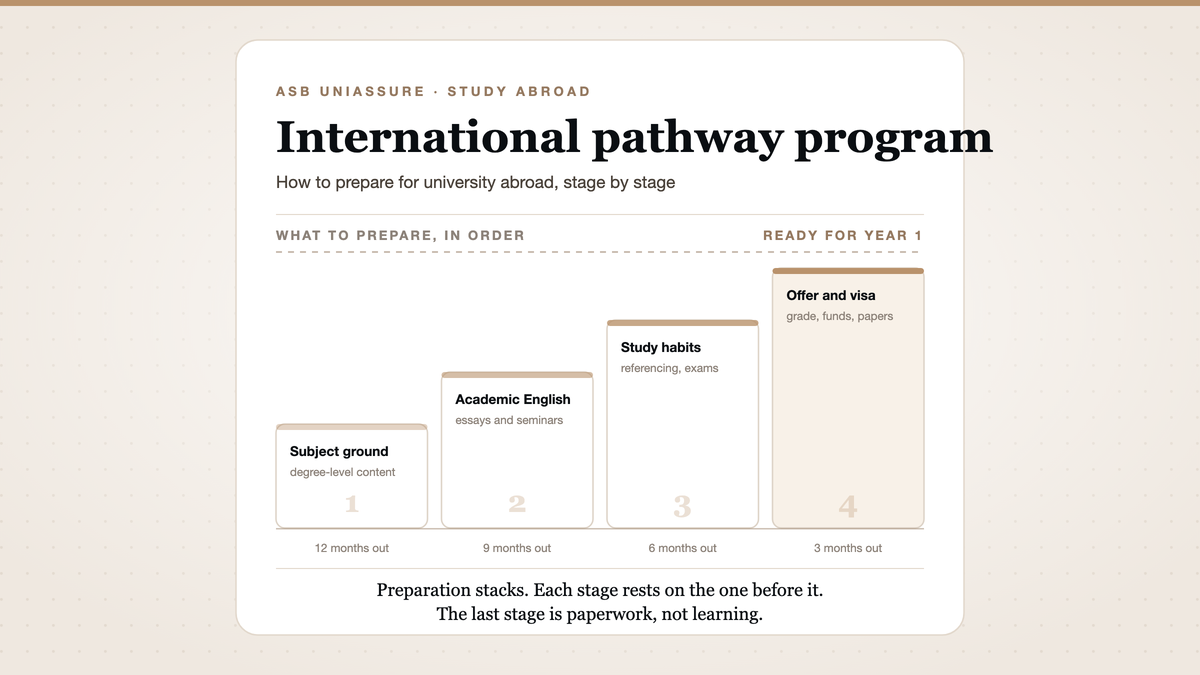
- Preparing for an international pathway program runs in four stages over roughly a year, and the order matters more than the effort spent on any one of them.
- Subject ground comes first, because the teaching and every later assessment sit on top of it.
- Academic English follows, and it is assessed continuously through essays and seminars rather than settled by one test sitting, so it needs months of marked writing.
- Study habits come next, since a university assumes reading stamina and referencing from day one.
- The final three months are administrative: progression terms in writing, evidence of funds, and the visa.
- Students who invert that order arrive with correct paperwork and weak reading habits, which is the harder problem to fix once term starts.
Preparation for an international pathway program starts about a year before the intake, not the week the offer arrives. The stages stack in a fixed order, and each one rests on the one before it. Subject ground comes first because everything after it is assessed in that subject. Academic English follows, then the study habits a university assumes on day one, and only then the paperwork. Families who treat study abroad preparation as an admissions errand rather than a year of work usually arrive with the documents in order and the reading habits missing. This guide sets out what to do at each stage, and which parts genuinely cannot be left until the last term.
What preparation means on an international pathway program
Preparation is not revision. An international pathway program teaches first-year degree material, assesses academic English across the whole course, and ends in a progression grade, so the work you do beforehand decides how much of the year is spent catching up rather than moving forward. Students who arrive already reading at length and writing structured arguments spend the year building on that. Students who arrive without those habits spend the first term acquiring them, which is the term that sets the tone for the grade.
| Stage | Rough timing | What it produces |
|---|---|---|
| Subject ground | About 12 months out | A shortlist and the reading behind it |
| Academic English | 9 to 6 months out | Written work someone has marked |
| Study habits | 6 to 3 months out | Referencing, notes, exam technique |
| Offer and visa | Final 3 months | Written progression terms and a visa |
Those timings are a working shape rather than a rule. Work backwards from the intake date on your offer, because a January start compresses every stage by six months and changes what is realistic.
Twelve months out: subject ground and a real shortlist
The first stage answers two questions: which subject, and which universities will accept the preparation year you are about to pay for. Getting these the wrong way round is the most expensive ordinary mistake in the process, because a general course that keeps the options open also delays the subject reading by a year.
Start with the degree, not the destination. Read the first-year module list for three or four degrees you are considering and note which topics keep appearing. Those are the topics a specialist route will teach. If you already know the field, a subject-matched option such as a business pathway program covers the modules the department expects rather than transferable skills you will not be examined on.
Then check progression. A pathway is only a route when a named university has agreed a grade against a named degree, and that agreement is what the year buys. Our complete guide to pathway programs sets out how progression clauses are written and what to ask for in advance. Anything vaguer than a grade, a degree and a university is teaching without a route attached.
Nine to six months out: English that gets assessed, not tested
An international pathway program settles entry with a test score and progress with continuous assessment, and this is the stage most students underestimate. Entry to the course is usually settled by a test score, but progress on the course is settled by continuous assessment. The two demand different preparation, and coaching aimed only at the first leaves a gap that shows up in week three.
| Entry test | Course assessment | |
|---|---|---|
| Format | One sitting, fixed tasks | Essays, seminars, presentations |
| Length of writing | Around 250 words | 1,500 words and upward |
| Sources | None required | Cited and referenced |
| Feedback | A band score | Written comments you act on |
| Preparation that works | Timed practice | Marked drafts over months |
The practical move is to write something long enough to be marked, every fortnight, and to have a teacher comment on the argument rather than the grammar. If your entry score is the only gap, fix it first and cheaply; our comparison of IELTS, PTE and TOEFL covers which test suits which candidate. If the score is already comfortable, spend this stage on length and structure instead of another sitting.
Six to three months out: the habits a university assumes
Universities abroad, and every international pathway program that feeds them, assume a set of working habits from the first week and rarely teach them. Contact hours are lower than most school timetables, and the hours that disappear are meant to be spent reading. A student who has never planned their own week will lose most of that time before anyone notices.
Four habits carry the most weight. Reading at length, meaning forty pages of academic prose without stopping, because module reading lists assume it. Note-taking that records the source alongside the point, which turns into referencing later without extra work. Referencing itself, in whichever style the department uses, since unattributed material is treated as misconduct rather than an error. Finally, exam technique under timed conditions, because coursework rewards care and examinations reward speed.
Build these on material you actually enjoy. The habit is what transfers, not the topic. Three months of steady practice on ordinary reading beats a fortnight of intensive drilling on past papers, and it costs nothing beyond the time.
The last three months: offer, funding and visa
The last stage before an international pathway program begins is administrative, and it runs on deadlines rather than effort. Every item here has a queue behind it, so late starts convert into missed intakes rather than late arrivals.
| Item | What to confirm | Why it slips |
|---|---|---|
| Progression terms | Grade, degree and university, in writing | Verbal assurances do not survive an appeal |
| Deposit and refund | What is returned if the visa is refused | Policies differ sharply between providers |
| Funds evidence | Balance held for the required period | The clock starts before you apply |
| Visa coverage | Whether one visa spans preparation and degree | A second application means a second wait |
| Accommodation | Whether university housing covers this stage | Preparation students are sometimes excluded |
Deadlines are public, so treat them as fixed points and work back. The UCAS application deadlines govern the degree application in the UK, and the official Student visa guidance sets out what a sponsor has to confirm and how long funds must be held. Budget the whole run rather than the next payment; our breakdown of study abroad costs gives the living-cost side by destination.
Preparation mistakes that cost students a year
Three patterns account for most of the avoidable damage. The first is treating the entry test as the finish line, which leaves a student technically admitted and practically behind. The second is choosing a provider on the headline fee, then discovering that the teaching hours, the resit policy or the accommodation sit outside it. The third is starting the paperwork last, which is correct in sequence but wrong in lead time, because funds evidence and visa slots both have waiting periods attached.
There is a fourth worth naming, which is preparing for an international pathway program that you do not need. If your results already clear the published entry bar and your English score is comfortable, the honest answer is to apply directly and keep the year. Preparation earns its cost when it removes a risk you actually carry, not when it buys reassurance.
Work the stages in order, confirm the progression terms in writing before any deposit leaves your account, and give the final three months to administration rather than learning. Prepared that way, an international pathway program does the one job it is sold to do: it turns a likely rejection into a stated route, and it does that without costing you the extra year that a refused direct application usually does.
Talk to a counsellor
Tell us the country and course you are aiming for and we will map out your eligibility, costs and timeline for the next intake.
Got Questions? We've Got Answers.
Everything you need to know about ASB Uni Assure's services and your global education journey.