
University Pathway Program: A Complete Guide for International Students

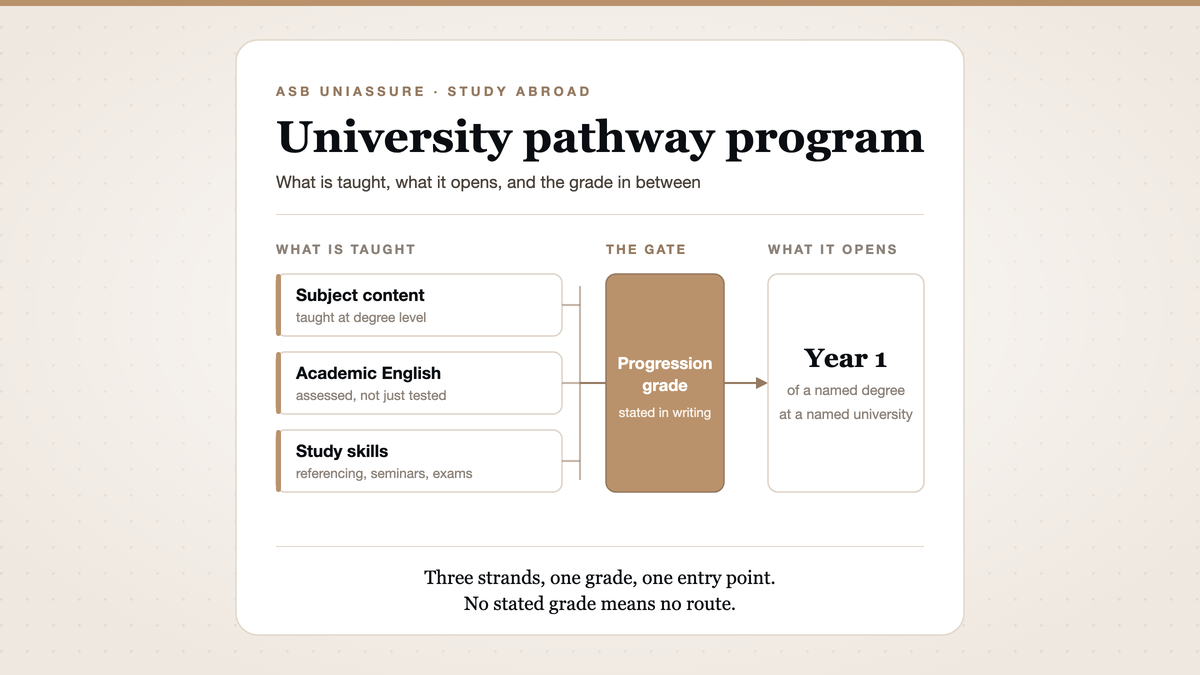
- A university pathway program runs subject teaching, academic English and study skills together over two or three terms and ends in a stated progression grade.
- That grade is the whole product.
- When it is written into an offer against a named degree at a named university, preparation converts into entry without a second application.
- When it is absent, you are buying teaching and applying again from scratch.
- Length, contact hours, English exit level, resit policy and visa cover all move between providers, so compare the full run to graduation rather than the advertised fee, and confirm the progression terms in writing before you pay a deposit.
A university pathway program is a preparation stage, not a shortcut through a degree. It teaches subject content at degree level, assesses academic English instead of testing it once, and ends in a progression grade that opens Year 1 at a named university. Most families ask what the year costs before they ask what it opens, and that order hides the part that decides the outcome. A university preparation program is only worth signing when the grade, the degree and the university are written into the offer in advance. This guide covers what is taught, how progression is decided, who the route suits, and what to check before you accept a place.
What a university pathway program actually teaches
Three strands run in parallel on a university pathway program, and they all end at the same gate. Subject content is taught at first-year degree level, so the syllabus is academic rather than remedial. Academic English is assessed through essays, seminars and presentations rather than a single test sitting, which is a harder and more useful demand. Study skills cover referencing, exam technique and independent reading, the habits a university assumes you already hold on day one.
| Strand | What it covers | How it is assessed |
|---|---|---|
| Subject content | Core first-year material in your degree area | Coursework and end-of-term examinations |
| Academic English | Essay structure, seminar discussion, source use | Continuous assessment across the course |
| Study skills | Referencing, note-taking, exam and reading strategy | Tutor review and graded submissions |
The subject strand is the one worth reading closely. A general course teaches transferable skills and leaves the degree choice open, while a specialist route such as a computing pathway program teaches the modules the degree department actually wants to see. If you already know the subject, the specialist version saves time later.
How the progression grade decides everything
Progression is a stated grade, not a promise of goodwill. The provider and the university agree in advance that a student who reaches a defined standard moves into Year 1 of a named degree without applying again. Miss the grade and you keep the qualification, but you rejoin the ordinary application queue with everyone else.
That single line is what separates a preparation year from a preparation course. Ask for it in writing and read it against four points: the grade itself, the degree it opens, the university named on the agreement, and what happens if you fall a few marks short. Providers differ sharply on the last one. Some allow a resit within the same cycle, some hold the place for the next intake, and some simply close the file.
Progression also carries an English condition alongside the academic grade. A student can pass the subject modules and still stall on the language exit level, which is why the assessed English strand matters more than the entry band you started with.
Who a university pathway program suits
Four groups get real value from a university pathway program, and everyone else should apply directly.
The first is students whose grades or English sit just below a published entry bar. A year of assessed teaching is a cheaper correction than a rejected application and a wasted intake. The second is students changing subject stream between school and degree, where a business or management route needs groundwork that school subjects never covered. The third is students moving between education systems, where the gap is less about ability and more about assessment style, contact hours and independent study. The fourth is students who cannot afford to lose a year, because a rejected direct application usually costs twelve months, a second set of test fees and another round of travel.
If your results already clear the published requirements and your test score is comfortable, apply directly. Paying for preparation you do not need is the most common avoidable expense in this part of the process. Our comparison of IELTS, PTE and TOEFL is the faster fix when language is the only gap.
Pathway, foundation year and direct entry compared
The three routes are often quoted as if they were interchangeable. They differ on length, on what the fee buys, and on where the risk sits.
| Stage | Direct entry | Foundation year | Pathway route |
|---|---|---|---|
| Before Year 1 | Nothing | Full academic year | Two to three terms |
| Entry to the degree | On results | Usually internal progression | Stated progression grade |
| Years 1 to 3 | Full degree tuition | Full degree tuition | Full degree tuition |
| Main risk | A missed offer costs a year | A weak year repeats the stage | A missed grade removes the guarantee |
| Degree awarded | Identical | Identical | Identical |
The degree at the end is the same document in all three columns, which is the point people forget when they compare prices. What you are buying with a university pathway program is a shorter preparation stage with a written progression term attached to it. We broke the arithmetic down in detail in our guide to pathway programme cost and time saved.
What the fee covers and what sits outside it
Quoted tuition is rarely the number you pay. Two offers can carry an identical headline fee and diverge by a wide margin once the practical lines are added.
| Line | What to ask | Why it moves the total |
|---|---|---|
| Contact hours | Teaching hours per week and class size | A cheaper fee with half the teaching is not cheaper |
| Progression terms | The exact grade and the resit policy | A high bar can turn one year into two |
| Accommodation | Whether university housing is available at this stage | Private rent for one year can exceed the fee gap |
| English retakes | Whether test fees are included | Repeat sittings add up quickly |
| Visa length | Whether one visa covers preparation and degree | A second application means a second fee and wait |
Visa packaging deserves its own conversation with the provider. How the preparation stage and the degree are bundled decides whether you apply once or twice, and the official UK Student visa guidance sets out what the sponsor has to confirm. Living costs usually outweigh the tuition difference anyway, which our breakdown of study abroad costs sets out by destination.
Questions to settle before you accept an offer
Put the offer on one page and answer five questions in order. What grade opens Year 1, and is that grade written down? Which degree and which university does it open, by name? How many teaching hours sit behind the fee each week? What happens if the grade is missed by a small margin? What is the total of tuition and living costs from today to graduation, on this route and on the direct one?
If any answer arrives verbally, ask for it again in writing. Admissions teams supply these details as a matter of routine, and a provider that hesitates on the progression clause has told you something useful. Funding follows the same rule: lenders treat preparation stages differently, so check how a study abroad education loan handles the stage in front of the degree before you assume the whole route is covered.
Answer those five and the decision usually makes itself. A university pathway program is worth paying for when it removes a real risk, converts a likely rejection into a stated route, and costs less than the year you would lose by applying directly and missing. When the grade is vague, the university is unnamed or the total exceeds what your funding can carry, the honest answer is that the university pathway program is the wrong purchase and a direct application in the next cycle is the better one.
Talk to a counsellor
Tell us the country and course you are aiming for and we will map out your eligibility, costs and timeline for the next intake.
Got Questions? We've Got Answers.
Everything you need to know about ASB Uni Assure's services and your global education journey.